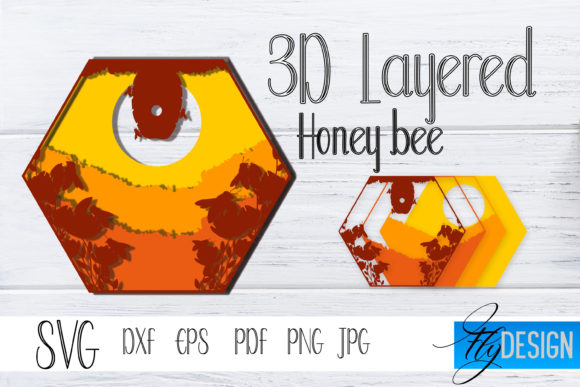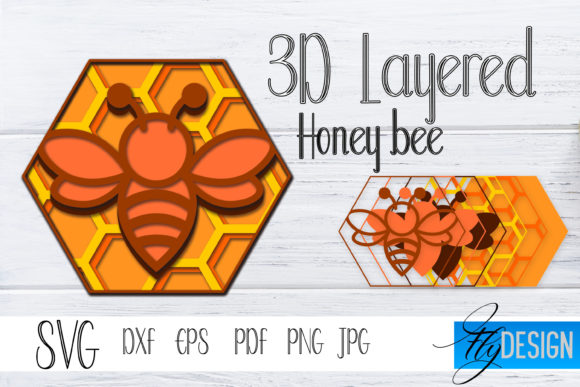
3d Layered SVG. Honey Bee 1 Design
A 3d Layered SVG. Honey Bee 1 is more than just a digital image; it is a structured blueprint for depth. Unlike standard flat graphics that rely on color to create dimension, this multilayered design uses distinct file layers to build a physical or visual shadowbox effect. When you open the archive, you are not looking at a single picture but rather a collection of cut paths that represent different planes of the same subject. This separation allows the honey bee to appear as if it is hovering above the background, creating a tactile experience when used in crafting or a rich visual texture when printed.
The core of this design lies in its architecture. The files are organized so that specific elements—like the wings, the body segments, and the legs—are isolated. This modularity is what transforms a simple vector into a complex project. Whether you are aiming for a paper craft that stands up on a table or a sublimation print that mimics a layered look, the underlying logic remains the same: precision alignment creates realism. The inclusion of a transparent PNG ensures that even without a cutting machine, the design retains its integrity for digital projects.
Why Different Creators Need Depth
The value of a 3d Layered SVG. Honey Bee 1 shifts depending on who is holding the tool. For a hobbyist, the appeal is often the immediate gratification of seeing a flat design become a three-dimensional object. It offers a sense of accomplishment that comes from assembling small parts into a cohesive whole. However, for a professional graphic designer, the priority might be the versatility of the file formats. They need to know if the vectors can be scaled without losing quality or if the layers can be easily edited in Adobe Illustrator before export.
Consider the perspective of an educator. A teacher might use this design to teach students about geometry, layering, and spatial relationships. The honey bee serves as a relatable subject, but the educational value comes from the process of deconstructing the image. Students learn that complex shapes are built from simpler components. In contrast, a small business owner selling handmade goods might view this asset purely through the lens of production efficiency. They need to know if the file works seamlessly with their Cricut or Silhouette machine to ensure they can produce items quickly without manual tracing errors.
Evaluating Ease of Use for Beginners
For those new to digital crafting, the term "multilayered" can sometimes sound intimidating. It implies a steep learning curve. However, a well-organized 3d Layered Cut File like this one is designed to simplify the process. The primary benefit for a beginner is that the software does all the heavy lifting regarding path creation. Instead of drawing every line of the bee manually, the user imports the file, selects the necessary layers, and sends them to the cutter. The challenge then becomes assembly rather than creation.
When starting out, the most critical factor is compatibility. Most modern cutting machines handle standard formats like SVG and DXF without issue. The provided ZIP archive includes these essential files, ensuring that users do not have to hunt for conversions. Additionally, the presence of a PDF file provides a visual guide. Beginners can print this sheet to see exactly how the layers should stack, reducing the frustration of trial and error. This support system makes the transition from novice to skilled crafter much smoother.
Priorities for Professionals and Entrepreneurs
Experienced users and entrepreneurs approach the 3d Layered SVG. Honey Bee 1 with a focus on reliability and commercial value. Their time is money, so the ability to manipulate the design quickly is paramount. They evaluate the file based on whether the layers are grouped logically. If the wings are separated from the body, can they be resized independently? Can the colors be changed globally across all layers? These questions determine the workflow speed.
For a seller of custom home decor, the flexibility of the design is a key selling point. A customer might want a honey bee for a nursery, while another wants it for a rustic kitchen. Because the design is multilayered, the seller can adjust the depth of the shadowbox or the size of the wings to fit different aesthetics. The inclusion of an EPS file is particularly valuable here, as it allows for high-resolution editing in professional software suites. This ensures that the final product looks crisp on large-format prints or intricate die-cuts.
Practical Applications Across Industries
The utility of this design extends far beyond the living room craft table. Marketers and bloggers often struggle to find unique visuals that capture attention without being generic. A 3D SVG of a honey bee adds a dynamic element to blog headers or social media posts that static images cannot match. The illusion of depth draws the eye, making content stand out in a crowded feed. Even educators can utilize the transparent PNG for presentations, adding a pop-up element to slides about pollination or nature.
In the realm of sublimation printing, the requirements change slightly. While the cutting files (SVG, DXF) are for physical separation, the transparent PNG is specifically tailored for heat transfer. Sublimation printers require a clear background to blend the design onto fabrics or mugs. By providing this specific format, the design caters to the technical needs of the printer, ensuring that no white borders ruin the aesthetic. This attention to detail shows a commitment to the end-user's success.
Making the Right Choice for Your Project
Deciding whether to incorporate this asset into your workflow depends on your specific goals. If you are looking for a quick, one-layer sticker, this multilayered file might be overkill. However, if your goal is to create a display piece, a framed art print, or a textured t-shirt design, the complexity is a feature, not a bug. The long-term usefulness of the file is high because the layers can be recombined in infinite ways. You are not limited to one interpretation of the honey bee.
Cost is also a consideration, but it is best viewed as an investment in quality. Buying a pre-made, perfectly aligned set of layers saves hours of manual work. For freelancers and publishers, the time saved translates directly into profit. The ability to produce high-quality, dimensional designs rapidly allows them to take on more clients and expand their service offerings. The design acts as a force multiplier for creative output.
Ultimately, the 3d Layered SVG. Honey Bee 1 represents a bridge between digital precision and physical creativity. It respects the skills of the veteran crafter while offering a guided path for the newcomer. Whether you are building a portfolio, teaching a class, or simply enjoying a weekend project, the layered structure provides the foundation for something truly special. By understanding the strengths of each file type included in the archive, you can unlock the full potential of this digital resource.