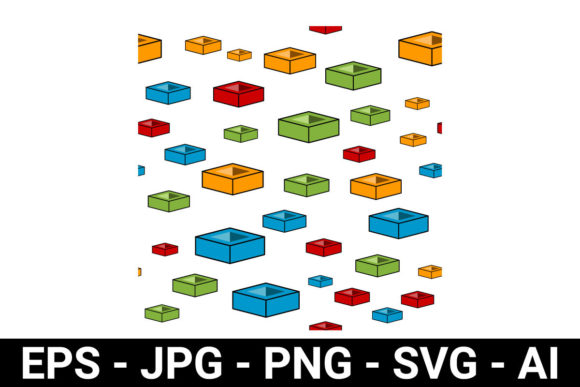
Colorful Isometric Box Seamless Pattern
In the realm of digital design and visual communication, the demand for versatile, high-quality background elements is constant. Among the various aesthetic trends that have gained traction over recent years, the Colorful Isometric Box Seamless Pattern stands out as a robust solution for designers seeking to add depth, structure, and vibrancy to their projects. This specific type of graphic asset combines geometric precision with playful color palettes, creating a visual rhythm that is both modern and engaging. For professionals evaluating design resources, understanding the nuances of this pattern—its technical specifications, application potential, and aesthetic impact—is crucial for making informed creative decisions.
The core appeal of this pattern lies in its structural foundation: the cube. By rendering three-dimensional blocks in an isometric projection, designers can create illusions of depth on a two-dimensional plane without the distortion associated with perspective drawing. When these cubes are arranged in a seamless, repetitive layout, they form a cohesive backdrop that feels organized yet dynamic. The "colorful" aspect introduces variability, allowing for gradients, contrasting hues, or monochromatic schemes that adapt to different brand identities or thematic requirements. Whether intended for web interfaces, print media, or textile production, this pattern offers a unique blend of minimalism and complexity.
Understanding the Composition and Technical Assets
When sourcing a Colorful Isometric Box Seamless Pattern, particularly within a comprehensive ZIP folder, users typically encounter a variety of file formats designed to cater to different stages of the design workflow. The inclusion of vector files such as AI (Adobe Illustrator), EPS (Encapsulated PostScript), and SVG (Scalable Vector Graphics) ensures that the pattern can be scaled infinitely without loss of quality. This is particularly important for large-format prints, such as wallpapers or fabric rolls, where pixelation would otherwise degrade the image.
- Vector Formats (AI, EPS, SVG): These files allow designers to manipulate individual shapes, adjust colors, and modify the scale of the hexagons, rectangles, or cubes that make up the pattern. This flexibility is essential for customizing the design to fit specific brand guidelines.
- Raster Formats (JPG, PNG): High-resolution raster files provide immediate usability for web backgrounds or quick mockups. The PNG format, in particular, supports transparency, which can be advantageous when layering the pattern over other elements or integrating it into complex compositions.
The seamless nature of the pattern means that the edges align perfectly, allowing for tiling across any surface area. This feature is critical for applications requiring continuous repetition, such as wrapping paper, wallpaper, or fabric textures. The ability to tile seamlessly reduces the need for manual adjustments, streamlining the production process for packaging and decor industries.
Aesthetic Versatility and Application Scenarios
The primary reason designers gravitate toward the Colorful Isometric Box Seamless Pattern is its adaptability. It serves as a bridge between abstract art and functional design. Unlike purely photographic backgrounds, which can be visually noisy, this pattern provides a structured grid that guides the eye without overwhelming the content placed upon it. This makes it an excellent choice for user interface (UI) design, where readability and visual hierarchy are paramount.
In the context of branding, the pattern can convey concepts of stability, growth, and modularity. The block-like structures evoke imagery of construction, building blocks, or data organization, making it suitable for technology companies, logistics firms, or educational platforms. Furthermore, the use of vibrant colors allows brands to inject personality and energy into their visual identity. A pastel version might suggest creativity and softness, while a bold, high-contrast palette could communicate innovation and dynamism.
Beyond digital screens, this pattern finds significant utility in physical products. Its repetitive geometry translates well to textiles, offering a modern twist on traditional brick or checkered motifs. For interior designers, it can serve as a distinctive wallpaper option, adding architectural interest to flat surfaces. In packaging design, the pattern can wrap around boxes and containers, providing a consistent and attractive look that stands out on retail shelves. The concept of "decoration" here is not merely ornamental; it enhances the perceived value of the product through thoughtful design.
Evaluating Tradeoffs and Considerations
While the Colorful Isometric Box Seamless Pattern offers numerous advantages, it is important to consider potential limitations. The geometric nature of the design can sometimes feel rigid or overly structured, which may not align with brands seeking organic, hand-drawn, or chaotic aesthetics. Designers must carefully balance the pattern's intensity with the rest of the composition. If the colors are too saturated or the contrast too high, the pattern may compete with foreground text or images, reducing legibility.
Another consideration is the level of detail required. Isometric illustrations often involve multiple layers of shading and highlights to achieve a convincing 3D effect. While this adds richness, it also increases the file size and complexity, particularly in vector formats. For projects with strict performance constraints, such as mobile apps with limited bandwidth, simplifying the pattern or using lighter raster versions may be necessary.
Additionally, the repetitive nature of seamless patterns can lead to visual monotony if not used strategically. To mitigate this, designers might incorporate variations in color density, introduce breaks in the pattern, or overlay additional graphical elements to create focal points. Understanding how to manipulate the pattern’s opacity or blend modes can also help integrate it more naturally into the overall design.
Decision-Making Framework for Designers
Selecting the right background asset requires aligning the visual properties of the Colorful Isometric Box Seamless Pattern with project goals. Here are practical insights to guide this decision:
- Assess Brand Alignment: Does your brand value structure, precision, and modernity? If so, the geometric clarity of isometric boxes is likely a strong fit. Conversely, if your brand emphasizes organic warmth or rustic charm, this pattern may feel incongruous.
- Determine Output Medium: For print-heavy projects like fabric or large-scale wallpaper, prioritize vector files (AI, EPS) to ensure crisp edges at any scale. For web-based applications, optimized PNGs or SVGs will offer faster load times and easy integration.
- Evaluate Content Hierarchy: Ensure that the pattern does not overshadow primary content. Use the pattern as a subtle backdrop by reducing its opacity or choosing a muted color palette. Reserve high-intensity versions for hero sections or standalone graphics where the pattern itself is the focal point.
- Consider Customization Needs: If you require specific brand colors or modified shapes, vector files are indispensable. They allow for non-destructive editing, enabling you to tailor the pattern precisely to your needs without starting from scratch.
In conclusion, the Colorful Isometric Box Seamless Pattern is a powerful tool in the designer’s arsenal. Its combination of geometric integrity, color flexibility, and technical versatility makes it suitable for a wide array of applications, from digital interfaces to physical packaging. By carefully evaluating its aesthetic impact and technical requirements against specific project needs, designers can leverage this pattern to create compelling, professional, and visually cohesive outcomes. Whether used as a subtle texture or a bold statement piece, it remains a relevant and effective choice for modern design challenges.